Friday, 26 May 2017

When Colours Clash - and more on Colour-Scaping the Culinary Patch.


When flower colour matters - and here at `Possum Creek' it does, boy it does - then bright pink blooms next to orange make me cringe. The flowers are swearing at each other and I'm almost physically uncomfortable.
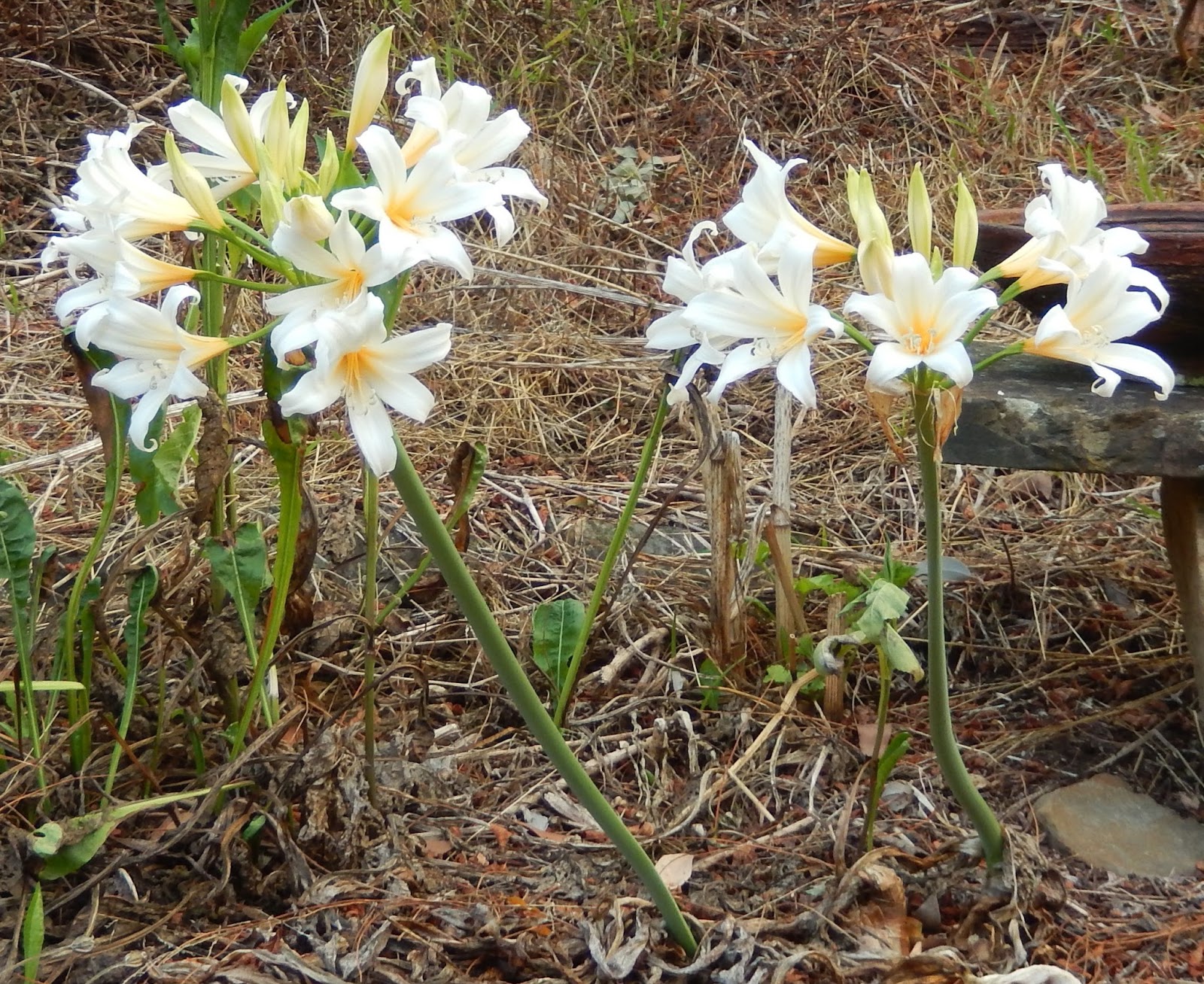
I thought I was always careful to avoid this! - but recently it happened: my pink-and-white cut-flower bed - full of pale pink Lillium (and one or two brighter (above) - how did that happen?), then belladonna lilies (last pic) as summer turned to autumn - was perfectly adjacent to a veg bed where I'd continued my recent fun and oh-so-satisfying colour-scaping the culinary patch. This bed - we've 5, with our 6 little hens frolicking in the fallow one - had orange pansies, African marigolds and nasturtiums (all plants with edible flowers) with that wonderful nasturtium, `Empress of India', all dark leaves (edible too) and near-red flowers, at the far end of the path amongst the black Tuscan kale. Purple broccoli and peas and dark-leafed lettuces and mustard greens continued the colour along with the red stems of ruby chard and, closer to the path, red beetroot.

I might have kept it all separate in my mind were it not for the wandering habit of the orange nasturtiums (above) which have climbed the short fence, poked their heads through the wire and grinned wickedly - and dropped lots of seeds. So...there is, now, a seed bank of orange flowering-plants, alas, right by the pink-and-white north cut-flower bed. (The other, southern, cut-flower bed is full of blues (Dutch iris), yellows (daffodils) and a tiny amount of red (Sprekelia).) No matter: it's not as if I want to grow pink nasturtiums (boy is that variety a bright AND strong pink) so I can just pull out any of the distinctive seedlings - so easily done - to avoid clashes.
Next time I plant out this patch I'll try to remember to keep it in pinks and/or purples.

I'm not trying to be `tasteful' but follow my own heart. I remember well looking up the British Yellow Book of gardens in 2010 to try to find open gardens in London while we were there. All of them sounded the same that week, and my memory, probably inaccurate, is of only `tasteful, colour-co-ordinated gardens'. No wonder (the late, great) Christopher Lloyd rebelled and planted, as he called it, colours that clashed...only with a masterful hand. You might think this skill takes 3 score years to achieve, were it not for Fergus Garrett, his (younger) head gardener, who maybe surpasses Lloyd in his skilfulness with plant combinations. It's worth, I think, dreaming up and trying out really interesting plant associations - considering leaves and texture and height and habit as well as that fleeting flower colour. (If I remember this right, he annoyed people when he announced that he'd planted pink flowers with yellow...only they weren't yellow, they were a gorgeous chartreuse, very different! (See `purple' and `yellow', above - contrasting colours, usually, that here - sing. Importantly, there's loads of green.) I guess when you have an old garden like Great Dixter, often open to the public (who have been told, repeatedly and erroneously, that it was designed by Edward Lutyens (who worked on the house with Christo's father)) and you write about it, then people feel that they own it to some degree. He could be provocative...and ahead of the crowd. I loved his story about the meadow at Great Dixter (below), perhaps one of the first, and - unusually - right at the garden entrance where there'd previously been lawn. (I saw this magical meadow in June, full of wildflowers, orchids and, I think, butterflies.) Apparently Lloyd heard some men say `he hasn't even mown his lawn! I'm not paying to go in there!' which made him chuckle. J and I loved this meadow and I'm currently designing 2 meadows with year-round flowers for country gardens to Melbourne's east.)
Since we last spoke, dear reader, I've begun a new edible patch, again in the hot colours, further down the hill. But instead of nasturtiums overwhelming the marigolds and pansies, I've kept to pansies alone as an edging to the path, for my edible flowers. Hopefully the growing vegetables behind will quickly take away any whiff of civic-like planting-style. Besides, they are deliberately not in a perfect straight line, just a rough line that fits with the path of wood-chip-mulch and the rustic wig-wams of teatree or paperbark branches (for peas) that arise from occasional clearing between house, fire pump and dam.
(Speaking of branches: we've had to cut down, early, a few tree dahlia canes - 2 or 3m long, and mulching them hasn't happened yet...and so, on Mother's Day, we had perfect, impromptu jousting sticks, or so my great nephews thought. I love an unpolished country garden where these happy chances can happen. This was after I got puffed playing chasey with these boys...yes, I am in my 50's. They also collected eggs from my hens and played - their idea - spoon and egg games. Outside.)
What's really different in my veg patch this time is that the colours include a lot of black, not just the Tuscan kale. The pansies go from orange to red to black. And the vegetables include a handsome black-leaf pak choy and a dark red-black mizuna with lacy leaves at the far end. There's also, near the start, kale with red stalks (home-collected seed; probably `Redbor') and scattered here and there, red onion seed (J: `You don't eat red onions.' Me: `But I will'. J: `You chose them for the colour, didn't you?' Me: `Of course!') and red beetroot and red-stalked ruby chard. (And purple broccoli.)
Home-collected seed labelled `mustard greens or black kale' has turned out to be very much the former, so I need to label the packet; but there's so, so much of it coming up persistently anyway that I think I'll pull it all out and replace with something dark and mysterious (and more useful); I just have to think what, here near the pea tripods.
Now some of you may be muttering that beetroot is red.
Well...down in my yellow patch (cream, lemon and yellow fading to gold patch, actually, thank you) there's a golden beetroot (I wonder what it tastes like?) along with chartreuse broccoli. There's yellow and gold-stalked chard (a plant I used to weed out vigorously...how times change) and pretty yellow peas (doing well) on rough tripods. I really like this bed, with its exuberant lemon nasturtiums (leaves and flowers picked for a salad last weekend). I'm curious to see just how cold it gets before the nasturtiums turn up their toes this winter...and maybe I'll put a cold frame over some - my plastic, easily moved one.
So my next bed might be pink and purple again: pink at the start of the path, leading to purples including rustic tripods for purple peas.
(A rainbow bed just didn't work, visually. Maybe my edible plots of about 4m by just over 2m with either a central path (J's choice) or a few bluestones as stepping stones (my preference) are too small for such a complex combination.)
I started colour-scaping the culinary patch a year or 2 ago and I think I'm addicted, as I think up new colour schemes and need to consider time of year - and plant or sow - summer or winter vegetables. As I'm collecting a lot of my own seeds it's getting cheaper, too (especially for the handsome kale that act as a backdrop but frankly don't get eaten much).
And I'm sowing lettuce seed mixes, frequently, for picking baby leaves for impromptu salads whenever we want.
Bon appétit!
Jill Weatherhead is horticulturist, writer, garden designer and principal at Jill Weatherhead Garden Design who lives in the Dandenong Ranges east of Melbourne, and works throughout Victoria (www.jillweatherheadgardendesign.com.au)

Wednesday, 10 May 2017

Five Shades Of Blue


Late autumn, and many of my beloved perennials are yawning and shuffling off to bed for their winter sleep. But not salvias, with maybe 20 kinds, of blue, purple and pink throughout the garden continually flowering, adding colour, mainly in petite blooms, and a magnet for honeyeaters.
Some of the blue Salvias are true blue, a rare colour in the vegetable kingdom, and reflect the sky, or replicate it, just as it clouds over on these chilly days.
But  how did I end up with five different blue Salvias, all near the lilac front gate? And why have I just noticed?

Well, it's autumn, when sun-loving sages peak and some, like midnight Salvia `Anthony Parker' (below), have just started to bloom. How I wish this one would start flowering at, say, the summer solstice (and continue for 5 months) but no, here at `Possum Creek' at 170m elevation it is not a team player but arrives like some self-important diva only to glance around disdainfully and disappear after (it seems) 5 minutes. I've pulled several plants of it out from in front of the yellow roses - it was too tall - and plonked the plants uphill where their quite neat sub-shrubbery works well and lack of floral decoration matters not a bit. And yes, now that it's flowering, nearly all is forgiven - for those dark, velvet blooms.
It's quite boggy near the front path and although Bog Sage (below) does not require this, nor does it mind it, either. Salvia uliginosa is one of those rather non-neat cottage-y perennials from the 1980's that still linger in some gardens - mainly, I suspect, for its glorious cool-climate-sky-blue flowers, and these have been blooming atop 1.8m stems for several months now. It's a plant I'm ambivalent about (at present very happy with); the random, almost wispy nature is forgiven as it wends about yellow Phlomis and purple iris without overwhelming either. (Yes, it wanders, but is so easily pulled out that it's no trouble. Maybe I like it now because there's enough of it for a reasonable impact.) I like having happy neighbours that flower at different times or in complementing colours, or effective contrasts. And it's also won me over by being neater than, and superior to, Salvia `African Sky'.
Salvia `African Sky' is at first glance a nice little perennial: it doesn't spread and it grows fast into a soft subshrub covered in little, mid-blue flowers for a good chunk of the warm months...but then looks just a bit too messy. I liked having a few along my front path over summer but they obscured (and competed too much with) other plants, got a bit tall and straggly over autumn and now almost overshadow the path. (I rather like its riotous laughing - but not along the edge of the front path, the only place where I want to keep a semblance of neatness.) I've started cutting them back and it's great to see the double row of green balls again, my spheres of Syzygium `Tiny Trev' which give this area structure amongst the softer perennials as we walk along the path to the front door. I will pull out the salvia (I'd rather have the iris and Phlomis flower) but...I have visitors coming in a week's time. I don't want this area messy and I like having some flowers here, they welcome people...so the execution date has been postponed. They don't need replacing; there's the Phlomis and iris, but, in front, also large leaved bugle (Ajuga) grows luxuriantly between the lilly pilly balls, a perfect marriage of carpet to feature, straight man to...star, as it were.
It's a long time since I acquired Salvia chamaelagiana; I believe I propagated and sold it when I had my mail order nursery of rare bulbs and perennials, Possum Creek Perennials, in the 1990's. It's stiffly upright which might work en masse but in small numbers can look self-conscious. I like the flowers of soft blue and white but they can look washed out from a distance; but it does have them for at least 2 months, maybe more. Currently it's uphill in awful clay soil, not complaining, just adding to the backdrop of pleasant perennials I've exiled from the garden proper. A dreadnought, as my hero, James Hitchmough, would say, and they are bloody useful.
There's one or 2 Salvia `African Sky' near the roses and they are too tall, too. So, how about Salvia chamaedryoides `Marine Blue' (above), a pretty little thing? On close inspection, the flowers have a touch of violet, although they look like a delightful fairly deep blue from a distance, over slightly silvery foliage. I'd like them at the feet of the roses, to hide their petticoats (so to speak) but I'm worried that this one is too messy and, because it needs cutting back in winter, won't do the job year-round. But...I love this garden of yellow and blue, and I think S. `Marine Blue' is probably the best candidate. (Alternatives could be: Salvia nemorosa (below)? Deep blue - but too short. Convovulus cneorum? Too small and silver. Correa? Too large and competitive...et al. But my existing S. chamaedryoides `Marine Blue' is goldilocks just right for height (reputedly 30cm, but almost twice that so far), colour, ability to blend in with that quality of perennials: it won't compete too much with the roses (physically or to the eye).) So...we cut back the Salvia when the other perennials are awake in spring, and distracting the eye, minimally at least. Let's see.
So my 5 salvias are very different. Salvia `African Sky' can be moved uphill, relegated to `The Gods' as my mother called the cheap seats at the theatre, high, high up above the real action. With a garden carved into the side of a hill, the flat areas are at a premium and plants relegated to the `batter' above are rather like undesirables cast outside the city walls.
I'll fertilise my Phlomis and iris and ask for forgiveness (these are just behind the green balls). Bog sage will continue its gentle invasion (and I'll continue its easy restraint). Over the path, in my garden of sunshine and sky, Salvia chamaedryoides `Marine Blue' will be trialled in front of the roses.
But it had better be good.
Jill Weatherhead is horticulturist, writer, garden designer and principal at Jill Weatherhead Garden Design who lives in the Dandenong Ranges east of Melbourne, and works throughout Victoria (www.jillweatherheadgardendesign.com.au)

Saturday, 22 April 2017

Purple Haze


You know those happy chances, where plants conspire, it seems,  to flower all at once with colours complementing perfectly, in a way you couldn't have planned?
As I look out from my kitchen window, on this cold wet autumn day, over the path I'm seeing one of these little vignettes that give such joy. The flowers are purple, but all in different shades and tints.

Uphill is a large shrub: chaste tree (Vitex agnus-castus, below), which is covered, just now, in tiny pale lilac flowers. Just below this is a perennial daisy on tall, firmly vertical stalks: purple Boltonia (last pic), which is oh-so-slowly forming a good clump, with intense shots of purple.

Next to this is one of my favourite of the ornamental sages, Salvia `Waverley': soft-lilac and purple blooms on a subshrub that doesn't spread (some salvias spread just a little too enthusiastically), along with a pelargonium I really like: one that tolerates half-shade, with leaves of silver-green, soft velvet, not dull, plebeian, rough felt (like many pelargoniums (or "geranium" in the Australian vernacular)). I have no idea of its name, but I love its effect: the handsome leaves year-round; the contrast to the flowers; the `volume' when some of the perennials slumber in winter (gardens need space and voids and volume).
There's a bit of a gap and I know exactly what is needed here: good old Mexican sage (Salvia leucantha, above): solid purple flowers that seem to be made of velvet. There's one further along the path and a couple more will - come next April - add some panache and continuity.
Well, that's the plan.
Jill Weatherhead is horticulturist, writer, garden designer and principal at Jill Weatherhead Garden Design who lives in the Dandenong Ranges east of Melbourne, and works throughout Victoria (www.jillweatherheadgardendesign.com.au)
 

Friday, 14 April 2017

Autumn bulbs (remind me of Mum).


From dainty-looking ivy-leaf cyclamen (Cyclamen hederifolium, above), to  flamboyant white belladonna lilies (Amaryllis belladonna alba), for me, autumn bulbs each have a story to tell.
Mum used to tell me that she bought her first cyclamen tuber around 1960 or 1961 and from the 1980's on had a great sweep of them, under deciduous trees, along her drive. After a while, ants spread the seeds to the nearby lawn so the beautiful leaves were turning up everywhere - to Dad's dismay.
At Macedon Joan Law-Smith grew it in ''sheets of pink and white'' at her wonderful garden at Bolobek. She once described the autumn-flowering C. hederifolium, with its dark green leaf and silver mottling, as ''a perfect example of nature's artistry in matching leaf to flower...No two are alike in size, shape or colour."
Both Mum and I grew cyclamen species from seed (mainly from the UK) to get a range that would give us flowers over a long period. In my 20's I read `The Urban Woodland' (1986)  by Suzanne Price, in which she describes cyclamen flowering year-round (in SE Australia) by growing C. hederifolium blooming in autumn, C. coum in winter, C. persicum in spring and C. purpurescens in summer - although I prefer C. repandum for spring flowers. I grow C. purpurescens by the front door and visitors (if gardeners) are often puzzled by the summer flowers; occasionally I get a non-gardener saying `I've got that' and I can't help but reply, about this rarity, `really, are you sure?' Most (of the plants, not the visitors) have patterned leaves that are very, very pretty - and (for this species) evergreen.
Just now my Cyclamen hederifolium are starting to bloom really well, while my white belladonna lilies have finished for the season.

I had just started to really enjoy gardening in my early or mid-twenties when I visited a bulb farm in Gembrook, not too far from my parents new home in Emerald in the Dandenong Ranges east of Melbourne. It was March 14th, my mother's birthday, and I bought 2 of these white belladonna lilies (above) - rare or uncommon bulbs - then, anyhow - (one for me, one for her) and was thrilled when the delightful farmer dug them up and left attached the perfect flowers, in enormous umbels, a heavy bunch on each stalk. I think he enjoyed my enthusiasm, too.
Most bulbs multiply well, which is part of their charm.
I tried counting my bulbs the other day. I'd picked 2 bunches at different times to enjoy inside and this left about 2 dozen flowering size bulbs (and many smaller). A good friend would be offering them around but I won't on two grounds: they are very top-heavy, making the pink one look elegant by comparison. I'll share that one. But also: I am using my white belladonna lilies for a massed effect, so I need the numbers. (Do other (lucky) owners of country gardens feel like this?) I love to share my garden plants, but some things I can't spare. (But I do give away hellebores, iris and obedient plant constantly.)

I still remember that day around 1988 driving into `Patnitop', as Mum and Dad called their property (after a mountain pass they loved in Kashmir), opening the boot, and delighting Mum with her showy birthday present, also called Amaryllis belladonna alba, with its heady sweet scent.

Then Dad sold `Patnitop' last year and we were allowed to dig up just a few of her bulbs - and it was autumn (see post 23/4/16).
My sister R and I spent a lovely hour in Mum's garden where the autumn bulbs had decided to put on one last hurrah; especially nerines in shades of red and pink, neon-lit and traffic signal-hot (and we oh-so carefully kept our unearthed treasures separate and labelled).
I've never had much success with nerines (yes, I know: the bulbs need the necks exposed, they need full sun, and the bulbs flower best when crowded). But Mum not only grew them well, but her magic lived on for several years and even into my garden - many are in bud, or flowering, now, despite my thinking a year ago - `should I really take these? - they won't do well!' It really feels like a bit of her green thumb wizardry is in the garden now that these are flowering. Some are bright raspberry pink, but with delicate slim petals that in no way dominate. They just add the tiniest spot of colour to the raspberry-and-silver bed, just as its perennials wind down with the cooler weather. Red ones (Nerine `Fothergilla Major', above) are further from the house but also add that welcome splash or dash of colour.
But what is this magic of Mum's gardening, that made nerines flower?
Well, Mum took her gardening seriously. (Plus she had good mountain soil.)
Maybe I just need to fertilise more regularly, garden, not just play and tinker.
There's a thought.
Jill Weatherhead is horticulturist, writer, garden designer and principal at Jill Weatherhead Garden Design who lives in the Dandenong Ranges east of Melbourne, and works throughout Victoria (www.jillweatherheadgardendesign.com.au)

Thursday, 6 April 2017

MIFGS 2017 - and More on Dahlias


Is there anything better than visiting a garden with a beloved sister? (Probably not.) Maybe going to a garden show, and looking at rare bulbs together? (Pretty darn good.) Or...looking at show gardens together at MIFGS - better than usual this year, don't you think? - and finding that you love the same ones, and heartily dislike the (one and only) same one; then investigating the rare bulb nursery stalls, each of us purchasing a few essentials - after a cup of coffee. (Well, no. It doesn't get much better.)
Last Friday was cool but dry when I met up with S at the Melbourne International Flower and Garden Show. I ignore the cut flowers and race to the show gardens to take photos - before the crowds build up, and it still feels friendly, and less claustrophobic (but nothing on Chelsea). This year many had really lovely watery effects but our favourite was simple and understated, by MPF Garden Co. (above), based on the 4 elements: air, earth, fire and water, with a twirling stainless steel sculpture (air) (by The Garden Element) and perfumed plant material: massed gardenias and star jasmine.
Another outstanding garden, with two black oblong infinity pools and deflated box balls, was `The Husqvarna Garden' (above) by Inspired Exteriors. We liked the soft perennials emerging around the squashed, box balls which changes the intent, the atmosphere, of the garden markedly.

(I could see both these garden, too - they weren't perched up high, like many show gardens, with burbling water above my eye line (or that of any child, and many other women). This was my gripe last year too, this inaccessibility. Should all gardens be amenable to the wheelchair-bound? To the old and short, like I'm starting, at last, to feel? (I'm 158cm (or 5'2") high.)
Please, landscapers, take a step back, sit on a chair, and assess. We want to see your creation, enjoy your magnificent vision, all of it. (And we've paid a bit to get in, too.) But full marks to the young landscaper who encouraged us to step up - one step of eight - to see more.)

The huge green bamboo stakes at the front of `Illusory Forest' (Taylor Brammer Landscape Architects) created a semi-transparent wall so, surprisingly, I needed to go to the side to see the path properly to understand the layout...and I liked this garden that needed a little more work, that didn't lay itself open to the gaze too easily. And it used my word - `coolth'! - that precious feeling, so hard to achieve, so fleeting in summer.
 
Colour schemes were fine this year; often simple, elegant and understated; my favourite this year was in the award-winning garden `Let's Talk Plants' (below) by Phillip Withers Landscape Design, with silver, grey, blue-grey, orange, bronze and pale apricot.
`Achievable gardens' designed by students were of a high standard this year. I loved "`Twitter' - A Social Media Garden" (by Kazimirs Krasovskis) while my sister (a chef) was impressed that so many contained wine glasses, and good places for them. (Are students drinking wine with their smashed avocado? The cheek! I jest.) She also loved the (mermaid) tea garden (Anthony Coyle) containing many plants - like lemon verbena - that you can make a tea with.
The Award of Excellence here went to `Awash with Nature' (Johnson, Peck and Beale, above) which showed deep-seated values (encouraging nature with its elegant insect hotel and plant choices; sustainability, recycling and reuse), simplicity and panache. More eclectic, even funky, but with that same ethos, was `The Four R's' (`fun, reduce, reuse and recycle' with `one letter [changed]', below) by Paul Morland, with colourful city panels, gambion panel-seats, a central round fire feature and a boab tree - all in perfect proportion.
But first I'd shown S the little pots of dahlias I'd just bought (Dahlia `Mystic Dreamer': softly pink, either 30cm or hopefully a bit taller (who knew which label to believe?), over dusky foliage) (top; already planted in the raspberry-and-silver bed (now all colours of a summer pudding)); then we raided the rare bulb nurseries (`I've wanted green Galtonias for years!' and so on. I give lots of (solicited) advice on what to plant where to this sister who loves gardening too). A chat over lunch, more gardens, more nurseries, then it's time to beat the peak-hour traffic home - just.
Lots to plant on the weekend...and lots to think about.
Perfect.
Jill Weatherhead is horticulturist, writer, garden designer and principal at Jill Weatherhead Garden Design who lives in the Dandenong Ranges east of Melbourne, and works throughout Victoria (www.jillweatherheadgardendesign.com.au)

Monday, 3 April 2017

Oh Dear, Candy-Pink Dahlias


When is a bargain not a bargain?
We-ell...I pounced on these dwarf dahlias in a nursery in early to mid-summer, and did something most uncharacteristic.
I bargained. What! Well, the tubers were very dessicated; at least one (in the pack of 3) was dead, and I thought I could resuscitate the others. Most of all - of course - I liked the colour on the packet: deep rose pink; and the variety - `Minikin Rose' - is a pretty single one with outward-facing (not drooping) flowers and was 35cm height: perfect for near the front in my silver-and-raspberry-coloured garden bed. Or Not.

So I plant and water my bargains, and underground the tubers swell with the moisture, then put up stems, leaves, buds, flowers...of bright candy-pink, garish.
Hideous, surely, wherever I put them? Near silver foliage? Nope. Amongst penstemons, half-hidden? Nup. In pots, to brighten up an area...only to scare away the sensitive eye seeking pictures in the garden, I'm sure.

Can you, ethically, give away a plant you hate, but someone else might like? Or, perhaps it's morally wrong to toss away a plant someone might like, wasting it. (I've done this: `You threw out pink lily-of-the-valley?' - wistfully spoken.) Plus, just because I think it's a hideous pink, I do get surprised at the high level of liking, no, love, for pink by some women...which I don't share at all. (I just like pink, purple and blue used harmoniously in the garden, and a small, controlled amount of silver foliage - with lashings of green. Yellow (with blue), in a separate bed, too.)

But tastes vary...
So if you would like this little plant, let me know soon (there are only two)!

And I must remember, I should buy plants - some bulbs, anyhow - in flower, not in packets.
Especially dahlias.

Jill Weatherhead is horticulturist, writer, garden designer and principal at Jill Weatherhead Garden Design who lives in the Dandenong Ranges east of Melbourne, and works throughout Victoria (www.jillweatherheadgardendesign.com.au)

Friday, 24 March 2017

Delightful Dahlias


Near my front door I have a few pots, just now, with engine-red flowers, that I feel say `Hello and Welcome'.
These are the ubiquitous 'Bishop of Llandaff' and I probably just bought one of its tubers years ago, and now they have multiplied and I have 3 huge pots of these near the front door. (Five - I just split the tubers apart in one, and repotted into 3 pots - normally done in winter.) `Self-supporting' (I'm no fan of staking) at about 1.5m high, the bright red flowers contrast so well with its anthracitic foliage and with all the surrounding green foliage. I love them and I'm not usually a fan of red, so what's going on? I think it's partly the sweet shape of the single flowers, and their perfect size and their height. But I think it's also that, just like in winter (only more so), Australian summers are a severe season for plants, and any Joie de Vivre Is welcomed. Luckily these red flowers are just far enough from the sun-and-sky (yellow and blue) bed and the silver and raspberry-colour bed to not swear terribly.
Is that important?
Heck, yes.

But...wouldn't yellow ones look better - being near the dwarf sunny ones along the front path edge? Ones with the same height as 'Bishop of Llandaff', and lovely, simple, sweetly-shaped flowers. (There was a dahlia show recently and I popped in for a quick look - to be impressed by the range of flower sizes; remembering the dinner plate-size blooms vaguely (not my thing) but enjoying seeing the mini-bloom varieties.) Clear yellow - no suffusing with apricot please - and that dark foliage would be welcome. I aim to buy one in a pot to be certain that I get one with the height I'm after (I want it to look me in the eyes), and multiply the tubers over time to give me several pots-worth and lots of welcoming faces near the front door.
Next week I'll be looking out for the perfect one at the Melbourne Flower Show when I go with my sister (unless I see one in a nursery earlier, but I am expecting the specialists at the show to have the greatest range).
We have fun together at the show, S and I, although this year she says that she has no room in her city garden for more bulbs - or plants, for that matter. I, however, have a country garden...and, so far, space for more plants. (Lucky me.) I'll get there early, to see the gardens before the crowds (I hope), then S and I love looking at the bulb nurseries. She likes dahlias too, so I will be able to do that sister thing - `do you like this one?' which I can't summon up interest for in fashion shops, but boy do I like doing it at plant nurseries.
That's my kind of shopping.

Jill Weatherhead is horticulturist, writer, garden designer and principal at Jill Weatherhead Garden Design who lives in the Dandenong Ranges east of Melbourne, and works throughout Victoria (www.jillweatherheadgardendesign.com.au)