Wednesday, 15 January 2014

Lilies in the Summer Garden


Another joy of the exclusion of munching marsupials from the garden is the flowering of the late lilies – true lilies, or Lilium. Just as various Narcissus give us blooms all through winter and beyond (`Paperwhites’ in June, gold `Soleil d’Or’ in July, perfumed creamy `Erlicheer’ in August and sunny daffodils and glistening white pheasant’s eyes in September), so the lilies give us flowers from late spring until mid-summer.
My sister was asking me about the different types and although there are now more groups, I like to think of these branches of the family that have been in the gardening world, spreading their joy (and often their perfume) these many years.
Asiatic lilies (below) start the show in November, varying from pink, yellow, orange, to white and red, with short-stemmed, often spotted blooms that stare at the sky and look wonderful in a vase. Hardy, easy; a good bulb to plant in Victoria.


Christmas lilies (Lilium longiflorum, below) are next with their cool white trumpets, delicately scented (to me; they may be stronger to others), pale green in the centre of the flower. The slim trumpet ends with tips that roll back elegantly.


Similar but heftier are claret-backed Lilium regale and other trumpet types which – to me – lack the ethereal colour and delicate demeanor, yes, even when there are 10 blooms on a stalk of a Christmas Lily;  Lilium regale will bow over royally in the garden and I detest the appearance (and work) of stakes.
January brings Lilium auratum varieties (below, bred from the Golden-rayed Lily of Japan) from white, gold-banded white, pale pink to deepest pink and outrageous cerise. Lightly perfumed, these can be tall in the garden, up to 2m, and have a real presence.


Another lily to brave summer’s heat is the Tiger Lily, Lilium tigrinum (below). If you are reading this, then the chances are good that you have seen this tangerine lily with reflexed petals, in an old garden; in an abandoned Australian garden it may be the last survivor (although silver Wormwood and pink autumn-blooming Belladonna Lilies may be keeping it company).
There are about 80 species and who knows - 1000s of varieties? But the main bulb companies show the colours well in their catalogues and sell new varieties each year; I might buy a couple that complement the garden where the bulb will have shade and the flower can reach into the sun and they should flourish.
And I have just broken the rules (it’s only slightly more expensive, though); I’ve bought a flowering pot of delicious moonlight lilies (top), a tiger lily cross I’m told. It will enhance my Sun and Sky bed wonderfully. That’s what it’s about.


Thursday, 9 January 2014

Spring in mid-summer (and goodbye - at last - to Skippy?)


Spring’s enduring rains combined with the new garden fencing (goodbye Skippy – so far) have lent a spring quality to the garden. Each day a new type of flower blooms, often bringing with it appreciative honeyeaters – although that doesn’t explain the grooming of the prolific, and – surely not still reproducing? – superb blue wrens. But it feels cool, green and moist here in the foothills so maybe they are following instinct as I did when I sowed pea seeds in spring – foolishly, I afterwards thought – only to be rewarded now with slim sweet pods. Instinct not intellect was spot on.
Honeyeaters love the Salvias of course but a new treat for them here is the large patch of moonlight Phygelius, handily by a sculpture from which to launch their nectar quests. This is in my sun and sky bed, filling with salvias azure and cobalt; Coreopsis bright-primrose and guinea gold; Anthemis lemon (yolk-centred) and white (gold-centred `Sauce Hollandaise’); deep amber Trollius chinensis, blue Siberian Iris and palest yellow Achillea or Yarrow. Gold Bidens weaves up through midnight blue buds of Salvia `Anthony Parker’ with sunny Gaillardia `Mesa’ (above) and soft blue Lobelia triconocaulis (below) at its feet.

In the sun and sky bed I try to keep the blues true; no purple to muddy the picture. Johan von Goethe wrote in Theory of Colours (1810) `As yellow is always accompanied with light, so it may be said that blue still brings a principle of darkness with it. This colour has a peculiar and almost indescribable effect on the eye. As a hue it is powerful, but it is on the negative side, and in its highest purity is, as it were, a stimulating negation. Its appearance, then, is a kind of contradiction between excitement and repose.’
More on blue flowers soon.

The newly replaced garden fence, less porous to the hungry herbivores, those wandering wallabies, is just a week old. Already effective elsewhere (excitedly I watch delicious pink roses weave through raspberry salvias, white campion, valerian, burgundy-budded Campanula and purple wallflowers), the yellow roses here are less forgiving, or too brow beaten. Expecting flowers immediately is probably unrealistic if not outrageously optimistic but do I need to wait until next – true – spring for yellow roses? (I hasten to add that wallabies are very welcome throughout our bushland; it’s just in my small country garden that they are unwanted.)
These are David Austin roses (such as `Graham Thomas’, below) so I am feeling quite hopeful for some summer roses here now that the munching marsupials have moved on. Let me know what you think of my chances. 


Jill Weatherhead  is horticulturist, garden designer and principal at Jill Weatherhead  Garden Design (www.jillweatherhead.com.au)


Friday, 27 December 2013

Spring seemingly continues…


All this fabulous rain has extended spring, or so it seems: wildflowers continue their colorful display, frogs are loud at night, and some garden plants are re-flowering (Philadelphus) or continuing like Fairy’s Fishing Rods (Dierama, one of my favourite perennials, above). Heck, we’re still picking peas (nibbling them, few reach the kitchen). Soon summer’s heat will sear the green but just now I am loving the profusion of little blooms, flitting birds and even the fleeting spring verdure of my tiny round lawn.

Jill Weatherhead  is horticulturist, garden designer and principal at Jill Weatherhead  Garden Design (www.jillweatherhead.com.au)


Tuesday, 24 December 2013

Happy Christmas


Jacobean Lilies (Sprekelia) have opened, as usual, just in time for Christmas – clever things. (A very British upbringing makes green and red the natural-seeming colours of Christmas for me. Holly was integral.) It’s a tough bulb for a sunny spot; mine are never watered but with few flowers, its time (more than time), after 10 or so years, to lift the crowded bulbs and replant further apart.
Yesterday I discovered that my sister calls them Scarlet lilies – a good name (although they are not liliums) but they are also known as Aztec Lilies in their home of Central America.
At about 40cm high Sprekelia  formosissima is great for picking for a vase and instantly the house looks like it’s joined into the festive spirit.
Happy Christmas!

Jill Weatherhead  is horticulturist, garden designer and principal at Jill Weatherhead  Garden Design

Monday, 23 December 2013

Cruden Farm’s Avenue of Gums


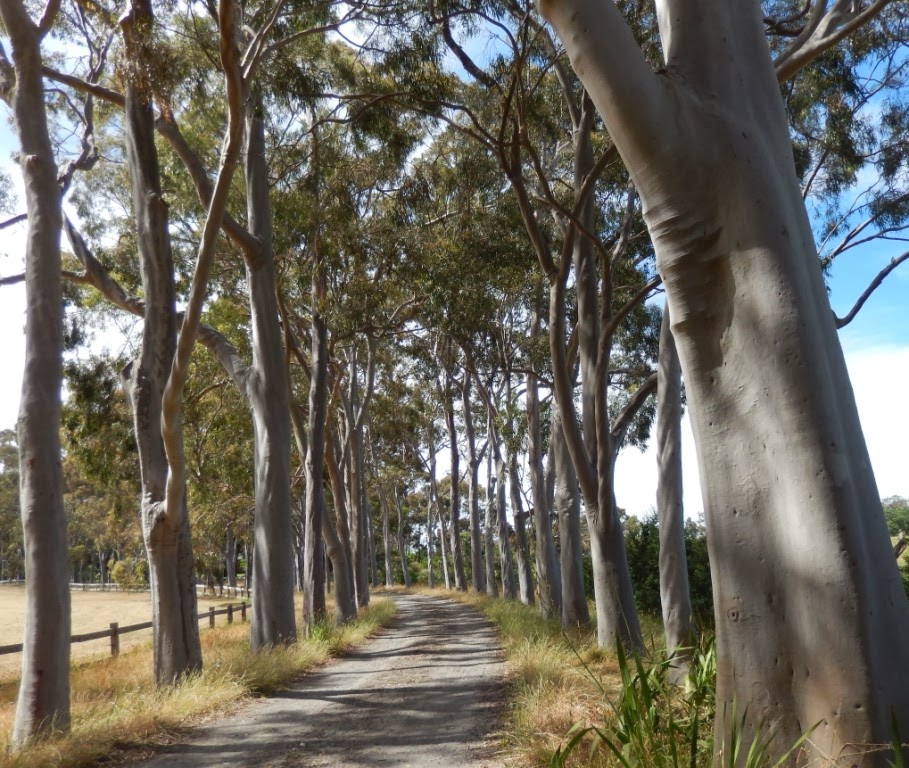
Cruden Farm opened its gates 2 or 3 weeks ago and beckoned for one reason: I wanted to experience again (and carry away a good photo of) that sinuous avenue of whitish gum trees. Designed by Edna Walling in 1930, and one of her best legacies (along with the garden at Mawarra which has amazing bones), it is superb, yet I remember it was derided – by other students - when I was studying horticulture in the late 1980’s.
Hopefully they have changed their minds.
But are they lemon scented gums as claimed (and suggested on her plans)? They are beige, not white, and some very dappled, and not too tall; they look like the terrific spotted gum (Eucalyptus maculata). Surely lemon scented gums would be too tall and out of proportion (while these sit perfectly)?


Cruden Farm has some other good ingredients: the walled garden (nice within, but with some shade-loving perennials (like Lady’s Mantle) mistakenly placed in full sun), some huge trees, some cool green spaces, the placement in the landscape. But it’s a strange mish mash with its plonked-down walled garden (hard to relate to the rest) and most of all, that rose garden.
But is Cruden Farm a sacred cow? Am I allowed to criticize it?
(Critiquing gardens has barely begun elsewhere and is regarded as suspect if not terribly impolite in Australia; but how else to regard gardens as art?)
Actually it’s only the rose garden that really jarrs, sitting uncomfortably amongst the green, with some odd bits of hedge, indigestible with its surfeit of blooms. But…it’s the rose garden where people wandered most, intoxicated by colour, pointing out blooms to their friends. (`I used to grow that.’ `Do you remember that one?’)
And the relevance to my own little patch? Well, once I dreamed of a similar avenue to my house, but I have a cottage, really, a 2-bedroom cedar house (see below). It’s just not a good fit. A grand design may not be required, precisely, but a certain size and presence is; Cruden Farm has this.
(To fire another volley, in another direction, to another family who have very kindly opened their garden gates: Musk Cottage does not; anything called calling itself cottage looks silly in 10 acres of gardened grounds. Our wild bushland, by contrast, is anything but groomed.
And there is a self-conscious wooden cottage - with dormer windows - not far from here which is rather pretty but, as if the owners have had a windfall, a heavy rotunda, Victorian mansion-worthy, sits in the back garden where – sadly – all can see it. It’s a great reminder to keep it all pitched to the same level.)
So what if I was stubborn, and planted that avenue, what then?
I think the visitor would be let down, at its end, by the country entrance to the home and garden: carport, wood shed, small home. No stately home, no superb circle of grass (great for turning cars as well as beauty and saying here the purpose changes); and that small (if artistic) gate to enter the home garden. In time, I hope this person will not be let down by my vision of the garden: beauty, interest all year, and strong ideas underlying the garden.


What to do?
Our sweetly curving drive is just right as it is, of course. It appears to wind through rough forest – a little thinned – and then our 2-storey cedar cottage is a welcome sight, sitting tightly on the slope, and our purple gate is a beckoning portal into the garden.
To add a grand avenue would be downright silly.
On our slope we have a small turning circle and it’s filled with mature gums and indigenous plants; good habitat on our Land-for-Wildlife property; this links home to property nicely.
Our scotch egg of home garden – pretty flowers and seats near the house; hens, edible patch and orchard below; surrounded by bushland with creek lower still – works perfectly. Birds dart in, echidnas wander through, skinks make a home about ours. Yes, wallabies eat my plants but the tranquility of our spot is wonderful.
I wouldn’t swap it for the world – or even that avenue.


Jill Weatherhead is garden designer, horticulturist and principal at Jill Weatherhead Garden Design www.jillweatherhead.com.au) working in Melbourne, the Dandenong Ranges and Victoria.


Tuesday, 17 December 2013

Flowering Fringe-Lily


It can be a roller coaster ride of emotion when you care deeply about your area. Today we celebrate 8 flowers of Fringe-Lily (Thysanotus tuberosus), a perennial herb in the bushland above our drive while moods plummeted last Saturday as we oh-so-carefully poisoned leaves of Nectaroscordum, an onion relative far too vigorous and spreading – everywhere! – hoping we were not harming little skinks, birds and frogs, but catching the bulb before it reached the forest.
Our long wet spring has lengthened the flowering season of many a plant and may have delayed the onset of this Fringe-Lily, which I generally find starts to bloom just when I want to mow the grass below the house prior to the hot summer season, as bushfire fuel reduction. These flowering ones, however, are safe: there is no grass, just dirt and a few herbs where horses trampled more than 20 years ago before we arrived. Suddenly it’s a positive: we can leave the little lilies to seed.
Like their colour, which stands out, I’ll go imperial for a moment: they stand at one foot high (almost 30cm) and while the flowers last one day, they are replaced by another and another…
This delicious little lily seems to love this sunny spot. Fringe-Lily may not have the vanilla scent of its cousin Chocolate Lily (Arthropodium) but I think it prettier and, frankly, any plant that can flower into an Australian summer has earned my admiration. (I am in the foothills of the Dandening Ranges; it’s just as hot as Melbourne in summer.)
Fringe-Lily is available from Kuranga Native Nursery and would be nice in a Christmas stocking, so to speak. After all, the tuberous root is edible – although that would be a waste.


Jill Weatherhead is garden designer, horticulturist and principal at Jill Weatherhead Garden Design www.jillweatherhead.com.au) working in Melbourne, the Dandenong Ranges and Victoria.

Sunday, 15 December 2013

White flowers at dawn and dusk (Part 2)


Another white flowering perennial to catch the eye at dawn and dusk is the statuesque Giant Hogweed (Heracleum mantegazzianum) with huge lace cap blooms on stalks that can dwarf a man. Also known as cartwheel-flower, giant cow parsnip, hogsbane, giant cow parsley, wild parsnip, or wild rhubarb, it self-sows gently, seemingly into just the right places.

Its size renders it formidable throughout the day; this one is not missish in the harsh light of day. But one magnificent plant is flowering near my kitchen window and gleams wonderfully as dusk descends, just as all the rest of the garden retreats from the eye and colours become invisible. I don’t remember planting this here; I think this one plonked itself there with a cheeky grin; a happy accident in this rather too-wild country garden.